Last Updated on May 21, 2026 by CU Staff
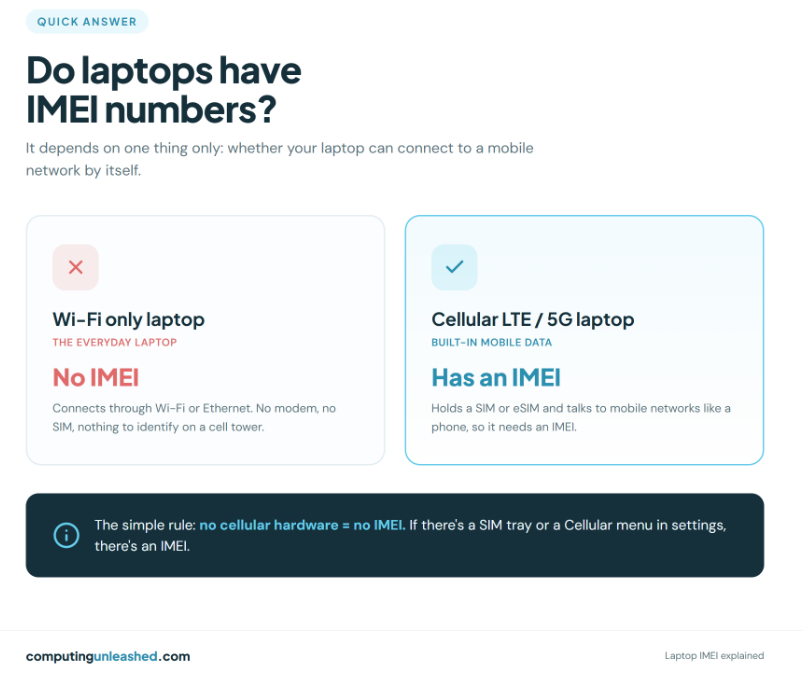
Most laptops do not have an IMEI number. Only laptops with built-in cellular connectivity, meaning LTE or 5G, carry one. A regular Wi-Fi laptop has no IMEI at all. Instead it relies on a serial number and a MAC address to identify the machine, both of which still matter if your laptop is ever lost or stolen.
If you came here wondering whether you can punch your laptop into an IMEI lookup the way you would a phone, this guide walks through what’s really going on, what your specific laptop has, and what to do if it goes missing.
What is an IMEI Number and Why Does it Matter?

IMEI stands for International Mobile Equipment Identity. It is a 15-digit number that uniquely identifies a device on a mobile network. Every phone you have ever owned has one, and no two devices share the same code. Think of it as a fingerprint baked into any gadget that can talk to a cellular tower.
The number gets assigned by the manufacturer and stays with the hardware for life. It does not change when you swap SIM cards, reset the device, or sell it to someone else. That permanence is the whole point. The SIM card identifies you, the account holder. The IMEI identifies the physical device.
Carriers lean on the IMEI for a few practical reasons. It lets them tie a specific handset to a specific account for billing. It also lets them blacklist a device. When someone reports a phone stolen, the network can block that IMEI so the device becomes useless on cellular networks, even with a brand new SIM inside. That blacklisting feature is why thieves care about IMEI numbers and why you should too.
So the keyword here is cellular. An IMEI only exists because a device connects to a mobile network. Take away that capability and there is nothing for the IMEI to identify. Which brings us to laptops.
What Kind Of Laptops have IMEI Number
Cellular laptops used to be a rare, business-only niche. That has shifted. Plenty of mainstream models now offer a version with built-in mobile data, usually marketed as the LTE or 5G variant of an otherwise normal laptop.
You will find cellular options across the usual business lineups. Lenovo’s ThinkPad range, Dell’s Latitude line, and HP’s EliteBook family have offered LTE and 5G models for years. Microsoft pushed this further with the Surface Laptop 5G aimed at business users, which builds the modem and antenna straight into the chassis. HP even runs a managed connectivity service called HP Go for its eSIM-equipped EliteBooks, which tells you how mainstream the always-connected idea has become.
A couple of points worth knowing before you assume your model qualifies:
- Cellular is almost always an optional add-on, not standard. Two laptops with the same model name can differ. One has the modem, one does not. Check the exact configuration you bought.
- 5G modems are backward compatible. A 5G laptop drops down to 4G LTE where 5G is not available, so it works on older networks too.
- Apple is the big holdout. As of now, no MacBook has a cellular modem or eSIM, so no MacBook has an IMEI. Apple has kept cellular to its iPhones and iPads. If you own a MacBook, skip the IMEI hunt entirely.
If your laptop has a tiny SIM tray on the side, or a setting menu for mobile data, it almost certainly has an IMEI. If it does not, it does not.
What LTE and 5G mean for your laptop
LTE stands for Long-Term Evolution. It is the 4G mobile standard your phone has used for years, and it gives a laptop the same kind of mobile internet without tethering to anything. 5G is the newer generation, with faster speeds, lower latency, and more capacity, especially in busy areas.
A laptop with one of these modems behaves a lot like a phone for connectivity. You drop in a SIM or activate a data plan, and the machine gets online anywhere there is signal. No hunting for Wi-Fi, no asking a barista for the password, no risky public hotspots. For people who work on trains, in cars, on job sites, or in any spot where Wi-Fi is unreliable, that always-on connection is the entire selling point.
This is also exactly why these laptops carry an IMEI. The moment a device authenticates with a carrier’s network, the network needs a way to recognize it. The IMEI is that handle. So the connectivity feature and the IMEI number are two sides of the same coin. You cannot really have one without the other.
Worth noting: cellular hardware adds cost, and the data plan is a separate ongoing expense. That is the trade-off for cutting the Wi-Fi cord. Most buyers decide it is not worth it, which is exactly why most laptops sold ship without the modem and without an IMEI.
eSIM laptops and the EID
There is a newer wrinkle that the older guides on this topic miss completely. Many recent cellular laptops have dropped the physical SIM tray in favor of an eSIM, an embedded SIM built into the motherboard. Instead of slotting in a tiny plastic card, you download a carrier profile straight to the machine. It is faster to set up and handy for travel, since you can load a local data plan without buying a SIM card.
eSIM laptops still have an IMEI for the modem itself. But they introduce a second identifier you may run into: the EID, or eUICC Identifier. The EID is a longer number (32 digits) that identifies the eSIM chip, the way an IMEI identifies the modem. When you activate a data plan, a carrier may ask for the IMEI, the EID, or both.
So if your laptop has no SIM tray at all yet still offers mobile data, you have an eSIM model. You will likely see both an IMEI and an EID listed in the same settings area. Don’t let the extra number throw you off. The IMEI is still the one used to identify the device on the network.
How to Find Your Laptop’s IMEI Number
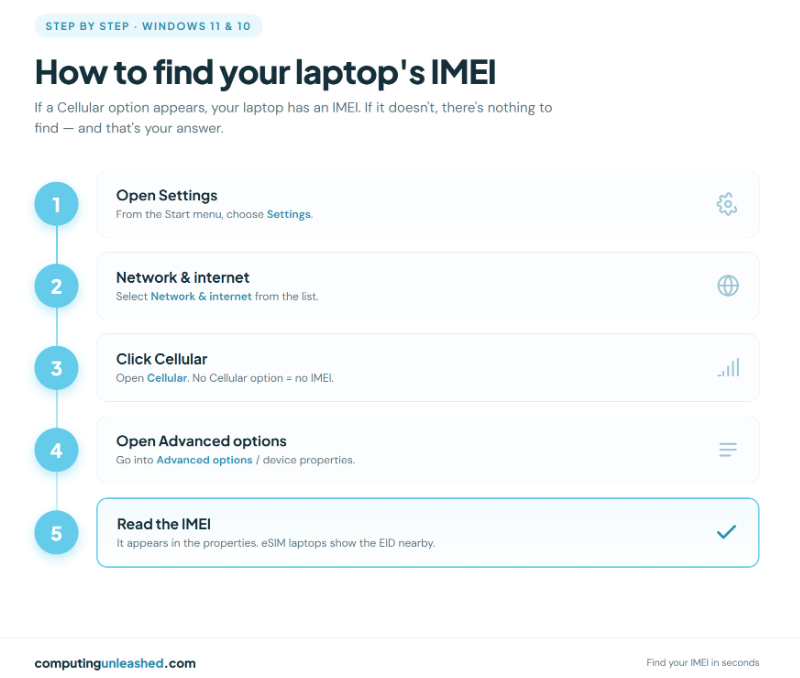
If your laptop has cellular, finding the IMEI takes about thirty seconds. Here is the path on Windows, which covers the overwhelming majority of cellular laptops.
On Windows 11 and Windows 10:
- Open the Start menu and go to Settings.
- Select Network & internet.
- Click Cellular. If you do not see a Cellular option here, your laptop has no cellular modem, which means no IMEI. That is your test right there.
- Open the advanced or properties section under Cellular.
- Scroll to find the IMEI listed in the device properties. eSIM models will show the EID nearby.
A few other places the number can hide:
- On a sticker on the bottom of the laptop, or under the battery on older models.
- On the original box and the receipt or invoice.
- In some manufacturer support apps, such as the utility tools that ship with ThinkPads, Latitudes, and EliteBooks.
Write the number down somewhere safe now, before anything goes wrong. Trying to dig up your IMEI after the laptop is already gone defeats the purpose. A photo of the sticker stored in your cloud account works fine.
This is where expectations need a reality check. The IMEI alone will not show you a map with a blinking dot on your missing laptop. It does not work like a GPS tracker, and you cannot type it into a website to see where the device is. Anyone selling you that idea is overpromising.
What the IMEI can do is help in a few specific ways. You can report it to your mobile carrier, who can blacklist the cellular modem so the laptop cannot get online over their network. You can also hand it to the police as part of a theft report, where it becomes a concrete identifier that ties a recovered device back to you. If the laptop turns up in a pawn shop or a police evidence locker, that number proves ownership.
So the IMEI is useful as a record and a recovery aid, not as a live tracking tool. And remember, it only exists for cellular laptops in the first place. For most laptops, the more important number for a police report is the serial number, which every laptop has.
How to track a laptop with no IMEI
Since most laptops have no IMEI, the real question for most people is how to find a missing machine without one. Good news: there are better tools for this anyway.
Built-in find-my-device features. Windows has a feature called Find My Device that, when turned on, can show the approximate location of your laptop through your Microsoft account at account.microsoft.com. Apple’s Find My does the same for MacBooks through iCloud, and it works even though Macs have no IMEI. Both rely on the laptop being powered on and connected to the internet to report a location. Turn this on today; it is free and takes a minute.
Anti-theft and tracking software. Dedicated apps such as Prey or Absolute can locate a device, lock it remotely, snap a photo with the webcam, or wipe sensitive data. Some business laptops ship with this built into the firmware. These tools are far closer to “real tracking” than any IMEI ever was.
The MAC address and serial number. Every laptop has a MAC address, a unique code tied to its network hardware, and a serial number printed on the chassis. Neither tracks location, but both identify the exact machine. Record them alongside your purchase details. If your laptop is recovered, these are what prove it is yours.
The honest takeaway is that tracking depends far more on software you set up in advance than on any built-in number. The number proves ownership after the fact. The software is what gives you a fighting chance of getting the laptop back.
IMEI vs serial number vs MAC address
People mix these three up constantly, so here is a clean comparison.
| Identifier | What it identifies | Which laptops have it | Main use |
|---|---|---|---|
| IMEI | The cellular modem | Only LTE and 5G laptops | Network blacklisting, theft reports for cellular models |
| Serial number | The whole laptop | Every laptop | Warranty, support, proof of ownership, police reports |
| MAC address | The network adapter | Every laptop | Network identification, IT management, ownership records |
The pattern is easy to remember. The serial number and MAC address belong to every laptop on earth. The IMEI is the special case that only shows up when there is cellular hardware inside.
Mistakes to avoid
A few common slip-ups trip people up around this topic:
- Assuming your laptop has an IMEI because your phone does. They are different categories of device. Most laptops simply do not have one.
- Waiting until the laptop is stolen to look for the number. Record your IMEI, serial number, and MAC address while the laptop is still in your hands.
- Believing an IMEI lookup can locate your laptop. It cannot. That is what find-my-device software is for.
- Sharing your IMEI or serial number publicly. Treat them like account details. Posting them in a for-sale listing photo, for example, hands useful information to the wrong people.
- Skipping the free tracking features. Find My Device and Find My are off by default for many users. Turning them on costs nothing and changes everything if the worst happens.
Tips for protecting your laptop
Whether or not your machine has an IMEI, a little prep goes a long way:
- Switch on Windows Find My Device or Apple’s Find My right now.
- Save a photo of the bottom sticker showing the serial number, and the IMEI if there is one, to your cloud storage.
- Keep your purchase receipt; it links the serial number to you.
- Use a strong login password or PIN, and enable device encryption (BitLocker on Windows, FileVault on Mac) so a thief gets the hardware but not your files.
- Consider anti-theft software like Prey if the laptop holds anything valuable or sensitive.
FAQs
Do all laptops have an IMEI number? No. Only laptops with a built-in cellular modem, meaning LTE or 5G models, have an IMEI. Standard Wi-Fi laptops do not have one at all.
How do I check if my laptop has an IMEI? Open Settings, go to Network & internet, and look for a Cellular option. If it exists, open it and find the IMEI in the device properties. If there is no Cellular menu, your laptop has no IMEI.
Do MacBooks have IMEI numbers? No. No MacBook has a cellular modem or eSIM, so none has an IMEI. You can still locate a missing MacBook using Apple’s Find My through iCloud.
Can I track my laptop using its IMEI? Not directly. The IMEI helps a carrier blacklist the device and helps police identify a recovered laptop, but it does not show its location. Find My Device or tracking software is what locates a missing laptop.
What is the difference between IMEI and serial number? The IMEI identifies the cellular modem and only exists on cellular laptops. The serial number identifies the whole laptop and exists on every model. For a police report, the serial number is the one most laptops will rely on.
What is an EID on a laptop? The EID is a 32-digit number that identifies the eSIM chip on laptops that use a digital SIM instead of a physical one. Cellular eSIM laptops have both an IMEI and an EID.
Does resetting or selling a laptop change its IMEI? No. Like a phone, the IMEI is tied to the hardware and stays the same through resets and ownership changes.
Summary
Most laptops do not have an IMEI number, and that is normal. The IMEI only exists on laptops with built-in cellular connectivity, the LTE and 5G models, because those machines connect to mobile networks the way a phone does. Newer cellular laptops increasingly use an eSIM, which adds a second identifier called the EID, but the IMEI is still the one that names the modem on the network.
If your laptop has cellular, you can find the IMEI in seconds under Settings, Network & internet, Cellular. If it does not, that menu simply will not appear, and you can stop looking. Either way, the smarter move for recovery is to record your serial number and MAC address, turn on Find My Device or Find My, and lock the machine down with a password and encryption. The IMEI proves a laptop is yours after the fact. The free tools you set up today are what actually help you get it back.
Related posts: